View Gabrielle’s work from her JOUR5990 food journalism seminar. Gabrielle is currently enrolled in this course as of fall 2025 and is one of the final courses she needs to complete her Bachelor’s degree in Journalism at The University of Georgia.
‘The Best Meal I Ever Ate’
Growing up half-Italian, food has been central to my family’s culture. I learned to make vodka pasta from scratch and sat through nine-course fish dinners every Christmas Eve. I’ve never been much of a cook — in fact, vodka pasta is the only recipe I can handmake well. You’d think, then, that the best meal I’ve had would be one of those generational Italian dishes. But it wasn’t. It was ice cream.
Rococo Ice Cream is a local, mom-and-pop ice cream parlor located in Kennebunkport, Maine. My family and I stumbled upon it in June 2015, after driving up to Kennebunkport from Boston. That summer vacation was the first time that all three generations of my immediate family were together: my grandparents, aunt, uncle and cousins included. We were all exhausted by the time we arrived in Maine. As you can imagine, Boston traffic made the drive a nightmare. We wanted something quick, easy, and delicious. So we settled on ice cream for dinner. I remember my mom pulling up TripAdvisor on her phone and researching “best ice cream shops in Kennebunkport.” I’m not sure how much research she actually did, as she selected the shop at the top of the list in less than 30 seconds — Rococo.
When we arrived at the shop, the sun was beginning to dip below the horizon, casting streaks of pink and gold across the waterline. As I stepped out of the car, I watched the light ripple across the harbor. Kennebunkport, perched on a short river not far from the coastline, hummed with summer charm. The hydrangeas burst in shades of blue, and the faint, buttery scent of lobster rolls drifted up the street from a nearby seafood stall. Except for the faint breeze on the water, Kennebunkport was quiet. My uncle pushed open the shop door, holding it for my family members to walk through. Inside, the shop was small, awash in pastel pinks, purples and blues. The walls were illustrated with feathers and elegant French women in robes à la française. As I walked up to the counter, I could smell lavender. The man working behind the counter could sense my curiosity.
“That’s our ‘Honey Lavender’ flavor. It has dried lavender infused with pieces of honeycomb. Would you like to try some?”
I shook my head yes and marveled at the flavor names as the man scooped my sample. “Goat Cheese Blackberry Chambord,” “Ube,” “Garam Masala” and “Olive Oil”– at the time, I’d never heard of some of these ingredients that made up the flavors at Rococo. The man handed me a tiny metal spoon from behind the counter. The moment the spoon touched my lips, I knew I didn’t care for “Honey Lavender.” I placed the spoon in the sample disposal dish and began to browse again. My eyes landed on a flavor named “Salty Sweet Cream.”
“Perhaps a take on vanilla,” I thought.
“Our signature sweet cream base,” the scooper said, again reading my mind. “It’s mixed with Mediterranean sea salt.”
“I’d like that one, please,” I replied.
“Are you sure you don’t want to try a sample again?”
I shook my head no as the scooper grabbed a small waffle cone for my ice cream. Cone now in hand, I followed my family outside to the wooden porch that wrapped around the shop. Adirondack chairs were scattered across it, all facing the harbor. I sank into one, the slats cool against my skin. I watched as the last bit of daylight shimmered across the water. The salty breeze carried laughter from the docks and the faint creak of boats shifting with the tide.
The ice cream itself was delicious — smooth, rich, unlike anything I’d ever tasted before or since. My family chose a variety of flavors, and each of them was thoroughly pleased with their selection. We came back to Rococo four more times on that trip for dinner. Though it wasn’t just the flavor that stayed with me. It was the quiet joy of that evening: my family gathered together and the water just beyond our feet. That porch, that harbor, that first bite of Rococo’s “Salty Sweet Cream” — it all became inseparable in my memory.
When I think of the best meal I’ve ever had, it isn’t entirely about the ice cream. It’s about that moment in Kennebunkport, where everything — family, atmosphere and taste — came together perfectly.
Comfort in each bite: A Night at Ted’s Most Best
Raindrops scattered beneath my espadrilles, the cracked Athens pavement pushing streams of water across my toes. My boyfriend, Michael, held an umbrella above my head as we ran through the streets. We ducked into Ted’s Most Best – a former tire garage turned eclectic eatery – and immediately felt the warmth of its laid-back glow.
Strings of twinkling fairy lights framed the open garage doors. The covered patio outside was filled with patrons; the rain didn’t seem to be a deterrent to their laughter. Inside, the scent of baked bread and roasted garlic hung in the air.
Ted’s has been part of the downtown Athens dining scene since 2011, named for local restaurateur and musician Ted Hafer. After moving to Athens in the 1980s with his band Porn Orchard, Hafer helped shape the city’s culinary identity through his iconic restaurant The Grit. Today, Ted’s carries that legacy forward — more than just a pizza spot, it’s a locally run gathering place.
On the car ride over, I craved something comforting and simple. Michael insisted pizza was the best Italian classic, but I had my heart set on pasta. By the time we stepped up to the counter to order, my decision was final: the pesto spaghetti, tossed in Ted’s house-made pecan pesto sauce, topped with shaved Parmesan and featuring roasted chicken.
When the plate arrived, the spaghetti was glossy and green, each noodle coated in the rich pesto. Thin shavings of Parmesan rested on top, softening and melding with the warmth of the pasta.
The pesto was nuttier than the basil-heavy versions I’d eaten elsewhere. I figured the kitchen had swapped the typical pine nuts for Georgia pecans. That touch gave the sauce a deeper, almost buttery flavor. The roasted chicken, although it made the dish heatier, leaned on the drier side.
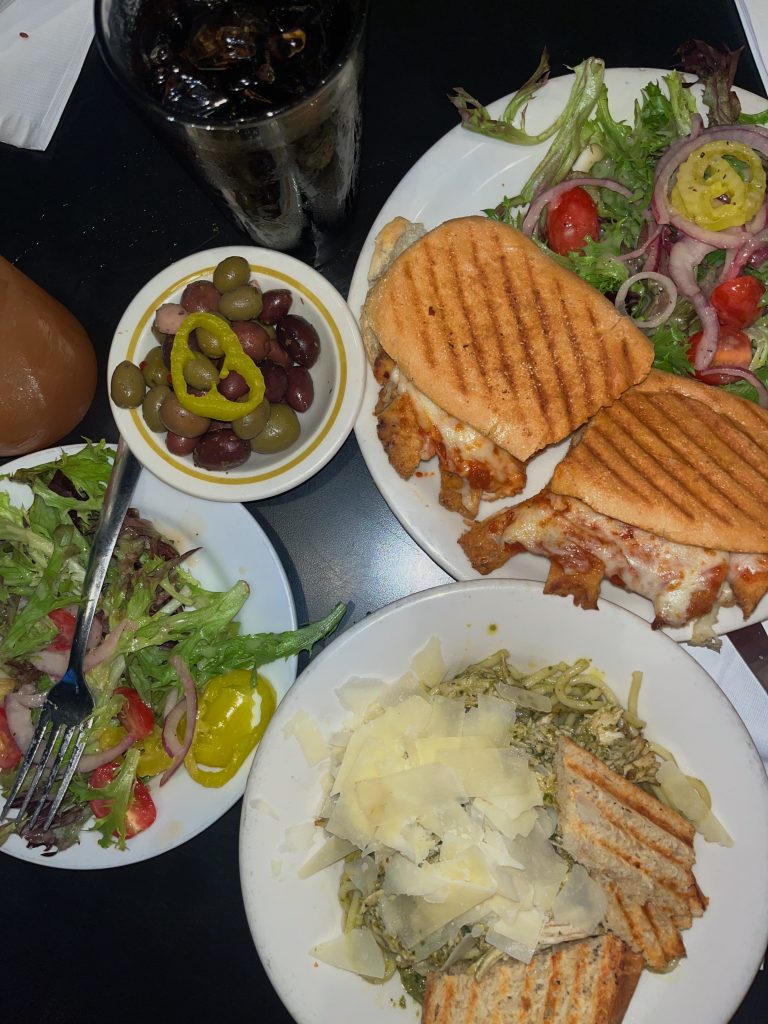
A pesto chicken pasta with focaccia bread and a chicken Parmesan sandwich with salad are served at Ted’s Most Best in Athens, Ga., on Sept. 5, 2025. The locally owned restaurant is known for its pizza, pasta and laid-back atmosphere.(Photo/Gabrielle Gruszynski)
On the side, I had a small house salad. Crisp and cool, the sharp vinaigrette cut nicely against the spaghetti. But it was the focaccia that surprised me most. It arrived charred and still warm from the grill. When I tore into it, the steam carried a yeasty, toasty aroma.
I spread a piece with the marinated olives we’d ordered to start — briny, herb-soaked and slightly bitter. Together, the bread and olives made my favorite bite of the evening.
Food has always been a shared experience for me, so I asked Michael what he thought as we ate. He reached across the table and grabbed a piece of focaccia from my plate.
“The bread was very good,” he said between bites. “Nice and soft but with a little bit of crunch on it. So it was baked very well.”
I had to agree. The bread didn’t try to outshine the pasta, but it lingered on my taste buds as I moved through the main course.
The pasta sparked more debate at our table. Michael gave it a “solid seven and a half out of 10,” noting his perceived thickness and dryness of the noodles. I could detect a hint of dryness, but the pesto carried enough flavor to keep me twirling my fork.
We also shared a glass of sangria, ruby red and full of fruit. The first sip was sweet and refreshing.
“Too much pineapple in it for my taste,” Michael said.
I rolled my eyes. I thought it paired perfectly with the olives and that he was just making a point of disagreeing with me.
As the night went on, the restaurant filled with college students and groups of friends, the patio buzzing with energy. The volume rose steadily. Ted’s felt less like a hole-in-the-wall and more like the heart of downtown Athens on a Friday night.
Michael and I compared notes as we finished eating. He was more critical of the chicken Parmesan sandwich he ordered.
“The sauce was good, very tangy and zesty,” he said. “[I’m a] sucker for good tomato sauce. What I disliked was [that] the chicken was a little dry. There was not enough cheese on the sandwich.”
I shrugged and smiled.
“It’s the kind of place you go back to when you want something casual,” I replied.
We lingered at our table, savoring the last bites of pasta and focaccia as the rain began to die down. The food made for a meal that felt cozy yet alive — just like the space itself. I mocked Michael’s picky comments, but couldn’t help smiling. It was the kind of night that made the simplest dishes feel special.
Rules of the market: What it takes to become a vendor at the Athens Farmers Market
Every Saturday morning, tents appear under the pavilion in Bishop Park, where the Athens Farmers Market (AFM) brings together local growers, bakers and artisans.
Yet before the vendors can set up shop, they have to pass through one of the most competitive application processes in the area.
“It’s a jury process … very competitive,” said Heather Russell, CEO of Piedmont Provisions and a 12-year AFM vendor. “You send in your application, and then it usually takes two weeks to a month to hear back.”
AFM’s board reviews applications annually, selecting vendors whose products meet the market’s standards for quality and community representation. According to AFM, applicants are encouraged to review AFM’s bylaws and operating policies, which outline vendor eligibility, product categories and selection procedures.
For returning vendors, the paperwork is manageable. For newcomers, it can be daunting. Applications require clear descriptions of products and motivations for joining the market.
“You have to write an essay about why you want to be in the market,” Russell said. “But once you’re accepted into the market, it’s pretty easy.”
This process is designed to diversify the market rather than crowd it. AFM carefully manages how many vendors can sell similar products, ensuring variety and fairness across categories.
Behind AFM’s vetting process is a patchwork of food-safety oversight, depending on what a vendor sells.
Georgia doesn’t issue a single “farmers market license.” Instead, regulation is divided among agencies: the Georgia Department of Agriculture (GDA) oversees packaged or processed foods, the local Department of Public Health inspects hot, ready-to-eat foods and the FDA’s Produce Safety Rule applies to larger farms selling fresh produce.
“From just a general, regulatory, farmers market standpoint, there’s not really anyone who is overseeing those markets,” said Dr. Laurel Dunn, an associate professor and food safety extension specialist at the University of Georgia. “The market itself and those vendors don’t have an all-encompassing regulation.”
For manufactured foods, the GDA ensures that vendors have the proper licenses and that products are made in approved facilities.
“If I make a hot sauce, that would probably be an FDA-regulated product that the GDA would be interested in making sure meets all requirements,” said Dunn.
Georgia’s most recent iteration of the Cottage Food Law, which took effect July 1, 2025, removed the state licensing requirement for cottage operators who produce low-risk food products at home. Items such as baked goods, jams and popcorn, for example, still need to follow labeling and ingredient standards, though producers face fewer administrative hurdles to sell at markets.
This change increases access for small food entrepreneurs.
“When I first started, we didn’t allow any cottage food businesses,” said Russell. “It’s more accessible now than ever before…for certain products like jams, jellies and baked goods.”
Regulation enforcement frequency varies by vendor category. Russell, whose business is licensed through the GDA, is inspected around once a year. She also received occasional FDA checks for her acidified products, like hot sauce. At the market itself, oversight mostly operates on trust — unless a customer complaint triggers a review.
Still, even with periodic inspections, small vendors often face challenges meeting day-to-day food safety standards.
“People have a tendency to forget gloves that should be used to protect the food,” said Dunn. “You’ll see someone make a sandwich and then turn around and take the trash out, and then collect money, and then make the next person sandwich. My hands are clean, my gloves aren’t.”
Dunn added that produce sitting in the heat or stored directly on the ground are frequent missteps that can affect both quality and safety.
For vendors seeking guidance, UGA’s Extension Program offers workshops on inspections, licensing and compliance. Dunn said the program teaches many of the courses required by the Georgia Department of Agriculture and the FDA.
There’s no shortage of help available, she added. The real challenge is knowing where to look.
The Athens Farmers Market may welcome newcomers, but success as a vendor still depends on preparation. Russell said the process rewards those who do their research and follow the rules.
“It’s a community,” Russell said. “If you put in the work, people notice.”
Jackson Kool brings precision and creativity to Cecelia’s Cake Shop
When I stepped into Cecelia’s Cake Shop in Athens, Georgia, the air smelled like sugar, buttercream and something warm — perhaps red velvet cake cooling on a rack.
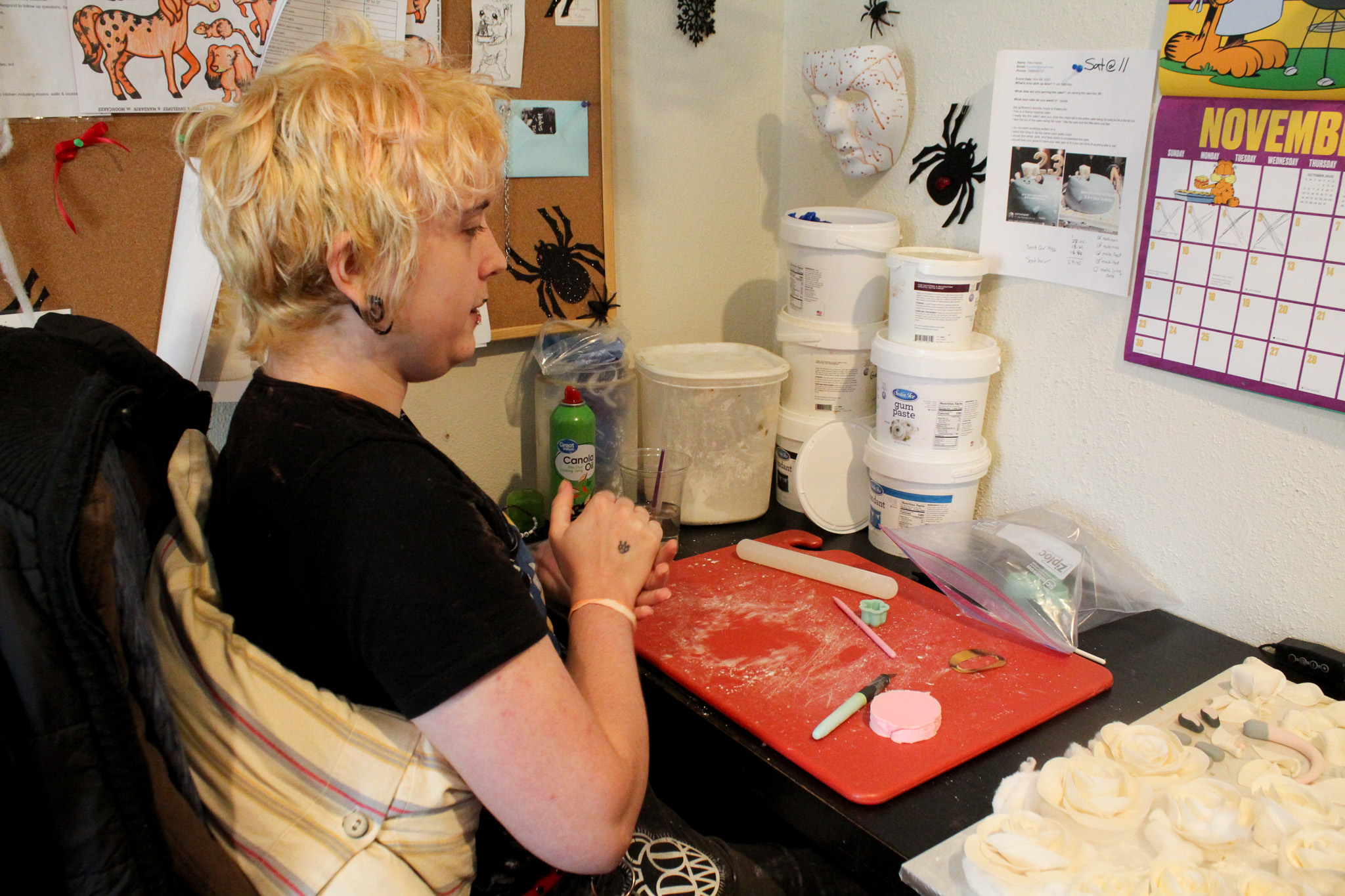
Behind the front counter, surrounded by half-frosted tiers and trays of fondant flowers, stood Jackson Kool. His hands were steady as he smoothed the edges of a flower with water and his fingers.
He barely looked up, lost in the rhythm of sculpting and spraying water on the fondant, as he transforms simple ingredients into art.
Kool, a fondant and cake decorator, has been a staple of the Cecelia’s team for the past three years.
His mother, Heather Kool, owns the bakery. It’s a cozy, family-run shop that’s become an Athens-Clarke County staple for its custom cakes.
It’s a true family affair: Logan, Kool’s brother, helps manage the front counter and the shop’s bookkeeping. Heather’s sister and ex-husband help in the bakery.
The shop hummed with the quiet diligence of a family endeavor, the kind of place where every pair of hands counted.
For Kool, it was a practical start that turned into something more.
“I don’t really have a GED, so it would be hard for me to get another job,” Kool said. “This is the easiest for pretty decent pay.”
That honesty sets the tone of most of Kool’s answers: straightforward but sincere. He didn’t romanticize his work. Still, as he talked about his favorite part of his job — fondant modeling — there was a spark of pride in his voice.
“Probably the fondant work,” Kool said, gesturing to pieces of a “Ratatoullie” cake perched on his work-station. “I made the tail, ears, a little nose and then the feet. And there’s a bunch of white flowers, but those are for a wedding order.”
The “Ratatoullie” cake, with its pastel coloring and expertly crafted details, looked more like a museum sculpture than a dessert. It’s delicate, playful and meticulous — much like its creator.
“He’s really good at his job,” said Lilli Childs, an associate of Kool and fellow baker at Cecelia’s. “He’s very motivated and concentrated on the stuff he does, and that makes his workflow go so fast.”
Kool’s expertise goes beyond fondant design.
“He can do pretty much everything,” Childs said. “All of the cream cheese, buttercream, the whipped cream cakes. He can do all of that and the fondant work.”
His attention to detail is evident in every cake he makes. Each morning, Kool begins by checking “the day’s list”: a lineup of cakes that need to be baked, iced or decorated.
“I typically come in about 8 a.m.,” Kool said.
His aunt, Holly, also works at the shop and creates the daily list that guides the bakers’ workflow.
“I just start icing cakes,” Kool said. “Usually it’s the whipped cream ones: Tres Leches, raspberry or strawberry. Then after that, I will do the pull list.”
The pull list, as Kool explained, helps prepare staff for upcoming orders.
“We make sure that all the cakes are ready and everything’s ready for us to make the next day,” Kool said with a half-laugh. “I have to be on my feet all day, and that definitely becomes an issue.”
Kool then mentioned his struggles with vertigo, which makes the physical stress of his job difficult.
Still, he shows up early each morning ready to tackle the next cake.
“He’s no-nonsense,” said Logan Kool. “He wants to get the job right. He’s mellow, not always super talkative. But he’s a good brother.”
That sense of quiet determination defines Kool’s presence in the shop. He’s not loud or attention-seeking, but he’s always moving — stacking, smoothing, cutting or painting.
However, Kool admitted that customer service isn’t his strong suit.
“I used to be the front desk person,” Kool said. “I pulled away from that because I felt like I was being rude or short with people. I had a script and I couldn’t let myself not do the script. I still have it memorized.”
Kool is more comfortable letting his work speak for him. When customers see the finished product — elaborate birthday tiers, intricate wedding cakes, character-themed designs — they’re seeing Kool’s touch.
The shop felt homey, with pastel walls, crowded counters and the smell of sugar in the air. That coziness makes sense as the building used to be a duplex.
That warmth extends to the recipes, which trace back to the shop’s founder, Cecilia Villaveces. Villaveces founded Cecelia’s in 1990. Her cake recipes are based on her Colombian heritage and still give the bakery its identity today.
Kool said his family has kept her recipes alive.
“Aside from having her original recipes, it looks different,” Kool said. “We do a lot of custom stuff. Almost everything that you can imagine, we can more than likely make.”
Sometimes, those requests can be quite unusual.
Kool noted having received an order for a red velvet cake with buttercream instead of cream cheese. Or the “Ratatoullie” cake he was working on. Customizing flavors, icings and fillings to match a customer’s taste is part of Cecelia’s craft.
That creativity is what, in Childs’ eyes, sets Kool apart as a staff member.
Kool and Childs bake lots of wedding cakes and go on deliveries together. In the decorating process, florals are a popular design choice for many couples. Therefore, attention to detail is incredibly important.
“He helps me pick where all the florals go,” Childs said. “They give us florals and we have to figure out where they go. He’s really good at that and at helping me.”
Childs smiled when describing Kool’s personality.
“He’s quiet most of the time, but once he gets comfortable, the jokes fly out,” Childs said. “When I first started working here, he made me feel welcome.”
That warmth extends to Kool’s sense of humor. One of his favorite stories from working at Cecelia’s comes from his days at the front counter.
“There’s this one guy, older gentleman, and I was handing him his cake,” Kool said. “He took it from me and just said ‘Thank you, babe.’ I blankly stared at him and then was like, ‘Okay, I guess I’m just gonna continue my work’,” Kool said.
Despite the occasional awkward encounter with a customer, Kool keeps his sense of humor and his boundaries. When asked if he had any final thoughts for anyone hoping to work at Cecelia’s or in cake baking, he didn’t hesitate.
“If you try to work at Cecelia’s, you can’t take my fondant job,” Kool joked.
For an individual who claims to not fully understand the “creative outlet” aspect of cake decorating, his work says otherwise.
Each fondant petal, delicate swirl of frosting and whimsical cake design carries an imprint of Kool’s personality: meticulous, steady and a little bit silly once you know where to look.
Cecelia’s Cake Shop is full of movement. On any given day, mixers whirl, industrial ovens beep and the freezer hums. But Jackson Kool’s corner of the bakery felt almost calm.
There, amidst the butter and sugar, Kool lets his artistry speak for itself.