Allaina Siler Introduction Post

Hey, my name is Allaina Siler, and here’s my introductory information!

1)   a) Although I haven’t taken any science classes at UGA, in high school I took Honors Biology, Honors Chemistry, Physics, and AP Chemistry.

b) My absolute favorite would have to be Honors Chemistry because I learned a vast amount of information about the different types of chemistry without the rigor and element of anxiety of AP Chem.

2. Because this will be the only biology (and science) class I’ll take at UGA, due to my art major and Spanish minor, I hope to learn as much as I can about how biology can relate to every-day life. Rather than simply viewing diagrams about a topic such as the cycling of nutrients, I want to get involved and experience it on a personal scale.

3.  I’d love to learn the ideal components of soil, as well as the different types of antibiotics that contaminate it, so I’ll understand how humans harm this particular facet of the environment. In addition, I’d hope to understand how I can compost as a student living in a dorm (on meal plan).

4. I think we could most appeal to students by informing them of the impact failing to compost has on their food. Because about every college student loves food, if we told them how their favorite dishes could be enhanced in terms of quality and flavor with the help of composting, they would take it seriously. Or, as global warming is a hot topic, the connection between composting and lessening the greenhouse gases would apply to them.

5. Because I abhor public speaking, I’d love to learn tools to both make myself and my potential audience more comfortable when I’m giving them information. I’d also love to learn different types of visual aids I could use to engage the audience.
Introduction


Hello!
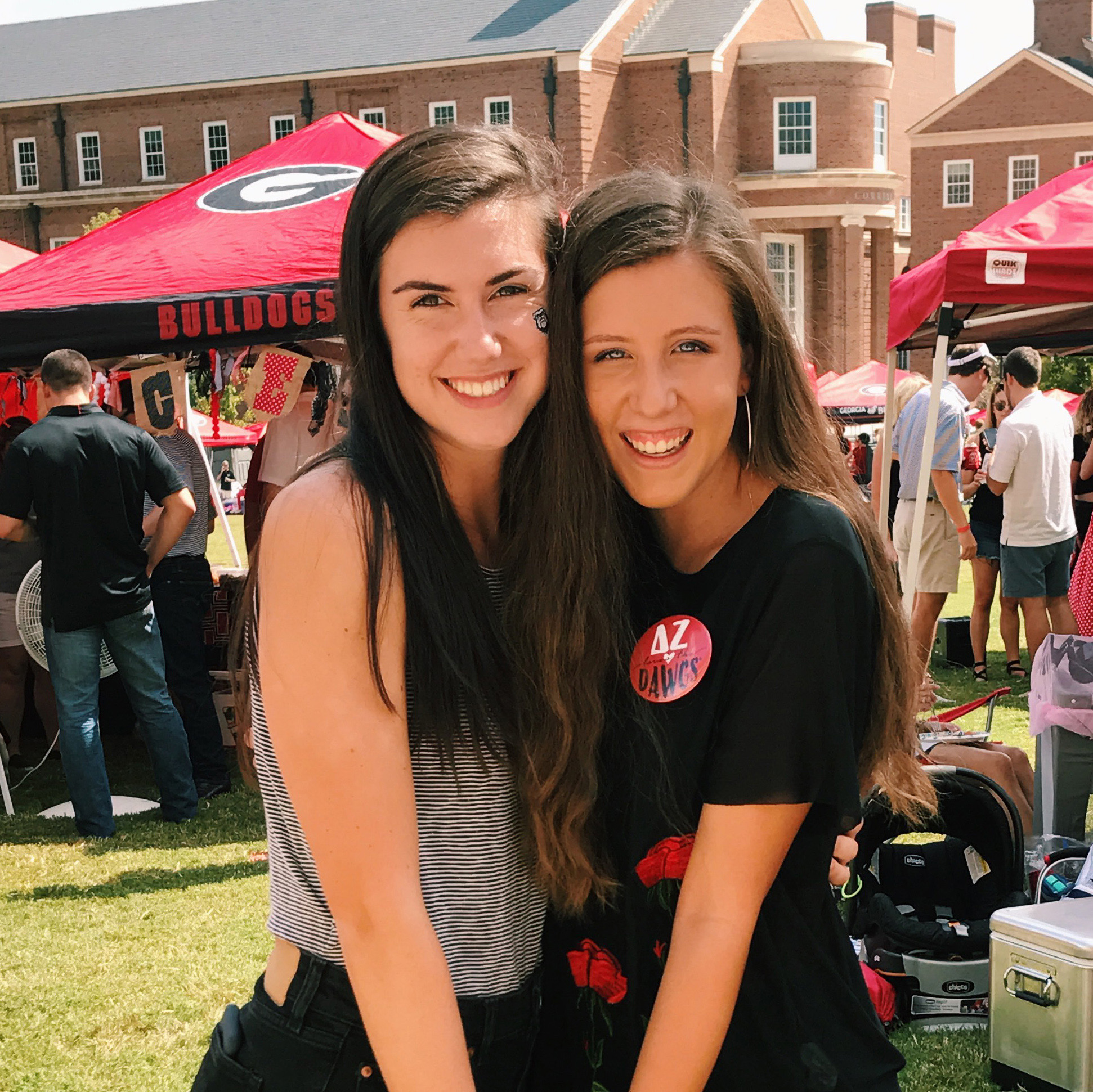
My name is Delaney Williams, (I’m the one on the right!) and I’m a graphic design major from Gainesville, Georgia. 
1. I took Honors Biology, Honors Chemistry, and AP Physics in high school and sequentially not taken a science course since. Biology was my favorite course because I felt like the material and content was more readily applied to daily life.
2. I am looking forward to the chance to actually apply the knowledge of the principles we learn to the world around us. Learning the material is great but as an art major, it’s not always easy to see how I can apply it in life. Hopefully, through this course, I will be able to bridge that gap between science and art.
3. In regards to the antibiotics, I’d ask what types are currently being found in our environment and what effect specific antibiotics leave. Are there certain kinds of antibiotics in the soil that have a positive impact, or do they all induce negative impacts? Furthermore, are there different ways of composting to help counteract the effects of different antibiotics?
4. In all honesty, the general student body will prove to be indifferent to the issues surrounding excess antibiotics in the soil. Mostly because they are unaware of the extent of antibiotics in the soil. If you go too far into the technicalities of the situation, students will brush off the danger. However, if you can effectively communicate the ease through which the negative impact can be combated in a simple and engaging way, there may be a few students who are drawn in. Those students will draw others and so forth until there are enough students who are willing to become active participants that the spectators will soon follow.
5. By helping with service learning, I hope to learn the extent of the impact youth and young adults can create, not just through formal education, but through civic engagement.


Vivian Lee-Boulton Self Portrait

I attended a liberal arts magnet high school that focused on social studies and English and was rather lacking in good science teachers. I took Biology my freshman year. The teacher was very sweet and I did well in it, but I learned very little and remember even less. However in comparison to the next three years of science, that course might have been my favorite science class from high school. Sophomore year I was stuck with a moody soccer coach for chemistry. My AP Physics teacher my junior year was a talented physicist, but had no idea how to teach to anyone without prior knowledge of several years worth of calculus and physics. Senior year I gave up and took Forensics, a joke class, so that I would get my last science credit and graduate, yet I still ended up with a disaster of a teacher.

I am very interested in the outreach portion of this course. As a public relations major, it is important to me to learn the best way to present information to the general public.

I am most interested in the composting portion of the class. My mom has her own garden and compost, but I have never taken the time to learn more about the actual process of how compost is made. I would love to learn more about the process of turning food waste into nutrient-rich soil.

I think that fellow students would be most interested in the reversing climate change portion of these issues. We are all young adults hoping to still have a healthy world to grow old in, and we want to better our environment.

Working with kids in high school could help teach us how to approach these issues in a way that engages younger generations and ensures that people in the future continue to make an effort to improve the environment.

Reflective Writing Assignment 1 – Self Portrait

  • Describe your previous experience with science:
    • Most of the science classes which I’ve taken have been physics based. I haven’t done anything relating to biology since my freshman year of high school, so it is nice to experience something different from what I’m used to.


  • What would you most like to get out of taking this course?
    • I’m really excited to talk about to social implications of how humans impact our environment. I think one of the most interesting anomalies in nature is our ability to shape the world around that, and I think I would enjoy discussing our responsibilities surrounding that.


  • As a student, what further information would you ask to find out about antibiotics in the soil or composting?
    • I would like to know what I can do to try to prevent this from spreading and becoming a bigger problem than it has to be.


  • Thinking about your fellow students, what issues do you think would appeal most to them about these issues?
    • I think prevention might also appeal to them in the same way that it does to me.


  • What are some examples of things you might learn relative to civic engagement by helping with this service learning
    • It will be interesting to see which parts of Athens suffer from antibiotic resistant bacteria, if other cities suffer in similar areas, and the various ways this can be reduced.


Idan Kirshenbaum’s Self Portrait

  1. My experience with science began with biology my freshman year of high school. I soon discovered that biology, while a very useful and important science, did not interest me at all. The following year, I took AP Chemistry. Although it was an extremely difficult course (with an equally difficult AP Exam), I enjoyed chemistry for the most part. My junior year, I was finally able to take the science that I enjoyed the most: physics. Although AP Physics 1 and 2 were difficult, I learned a lot in those classes. My senior year of high school I took AP Environmental Science, a class that I found quite boring. Overall, I enjoyed  physics the most because it isn’t an information-retaining science like biology or chemistry, but because I am a math-oriented person, and physics is a science that applies math to the real world, and this helped me understand physics the best.
  2. I would like to get two things from this class. Firstly I would like to acquire an understanding of what we, as humans, do to affect our environment, and how we can fix the negative effects and increase the positive ones. Secondly, I would like a good grade in this class, and I am hoping that the studying and work I will put into this class will yield positive results.
  3. I would like to know how different antibiotics affect plant growth, what antibiotics are found in the soil in different areas, and which antibiotics should we avoid putting in the soil entirely.
  4. I think my fellow students would be interested in finding a way to make composting more accessible and more prevalent.
  5. I am hoping that this class helps me be better able to present scientific data and explain information related to the environment.

Below is a picture of me with my sister who just graduated from UGA at a tailgate that my fraternity had.

First Assignment Self Portrait – Jackson

My previous experiences with science involve a childhood wrapped around my parents’ jobs either teaching environmental science, particularly stream hydrology, or applying science as a civil engineer focused on city water and sewage systems. In high school I took basic biology and chemistry, as well as AP Environmental Science, and in college thus far I have only taken Geology. What I’ve enjoyed most has been that Environmental Science course back in high school, as I felt it dealt with important matters to my and every person’s everyday lives, and appeared more immediately applicable than did chemistry and basic biology.

I would like to get a better understanding of the way the earth functions, as well as how human activies affect these processes.

In relation to antibiotics, I would like to get a better understanding of the spread of resistant bacteria in nature outside of direct human influence – how things are indirectly affected beyond our immediate actions

The issues that appeal to me the most, and therefore I assume appeal to others as well, is how I and they might be affected in the immediate and far off future by current human activities and mistakes.

Learning how to interact with the community and what can be done to help people are things I hope to learn through the service learning projects.

Self-Portrait Reflective Writing Assignment

I have a very beginner-level relationship with science. During high school, I took introductory classes in Biology, Physics, and Chemistry. Of those, I enjoyed Biology the most because of my teacher.

I’d like to learn about environmentally conscious practices and how to apply them as a future policy analyst.

As a student, I’d ask questions about how to increase composting across campus and how to make composting easily accessible to those living in dorms. For this reason, I’d be most interested in projects that involve doing so.

Ways to easily, almost thoughtlessly, contribute environmentally while still focusing on student life because of ways that environmental destruction impacts their individual lives, such as their home and the UGA Campus.

Things I might learn are the importance of civic engagement and how it can positively contribute to aspects of my individual life, such as food,  air travel, and more. 

John Kutteh- introduction

  1. Hello! My name is John Kutteh and I am a sophomore studying public relations from Memphis, Tennessee. I came into college as an undeclared science major, so I have taken a few semesters of chemistry and some other random science classes here and there. I took an anatomy class in high school that I really enjoyed as well as some other required science classes that were not as interesting, but necessary.
  2. I am very excited for our study of compost. I hope that I learn a lot and am able to use that information to convince the people around me to start composting.
  3. I would like to learn what can be done to remove antibiotics from the soil once they are there. It is a huge problem, but it must have a solution, however difficult it may be.
  4. I think my fellow students would like to learn more in depth about how composting can have a positive impact on the environment and how antibiotics in the soil can have a negative impact on the environment.
  5. I would like to learn how to effectively engage the community in order to enact real change within that community regarding environmental issues. 

Kunho Kim Self-Portrait

In high school, I took honors biology and chemistry my freshman and sophomore year, respectively. After that, during my junior and senior years, I took AP Physics 1, AP Physics C, and Environmental Science. I really enjoyed all of my AP science classes because we were able to more deeply discuss topics during class and were able to learn more material beyond the standard curriculum.

I hope to achieve a better understanding of general biology. I have not taken a biology class since freshman year in high school, so I hope that this class will be able to help me stay educated in biology. I also hope that through the projects we will be working on this semester, I will gain more experience working with other people in a group in different environments. Additionally, I hope to develop an appreciation for biology by taking this course.

What exactly is happening that is causing such a large increase in antibacterial resistant bacteria in the soil? Where is it the worst (locally and globally)? What can we do to prevent this? What measures are already being taken and are they effective? How is it affecting other life? What exactly is compostable? What can we do to increase the rate of compost being created?

I think composting would appeal most to the class because it seems slightly less daunting than antibiotics in a sense. Composting is something that anyone can start doing at any time– it seems like a very simple yet effective solution to helping preserve our Earth.

I think that I will be able to learn that everyone can play a part in protecting and improving the environment. If everyone began to recycle, compost, and be more aware of how they are affecting the environment, then I think that positive changes will immediately begin to happen to our environment.


Reflective Writing Assignment 1: Self-Portrait

  1. a & b . I took physics, biology, and chemistry my freshman and sophomore year of high school. At my school, we were allowed to pick one and continue it, so I chose chemistry which I then did for the following two years. I decided to continue chemistry because I excelled in it the most compared to the other sciences, and I also found the real-world implications of the chemistry topics to be very fascinating. This class is my first science class taken in college so far.
  2. I am interested in understanding more about my personal impact along with my fellow humans impact on the earth and perhaps ways in which I as an individual can have an impact on reversing the negative effects of our actions and presence here on the planet. I am looking forward to understanding more about the condition of our planet, because I feel we as a generation are becoming more and more ignorant to it.
  3. What exactly is the role of antibiotics in soil and the process of composing? Where can and do these antibiotics originate from? What are the long-term effects of antibiotics in the soil?
  4. I think that many students are concerned about global warming and the deterioration of the planet, but are reluctant to act because of a lack of knowledge. However, I feel that, with enough repetition and emphasis, students would be most receptive to the issue of global warming.
  5. Perhaps this experience will help me to realize that a single person or idea can actually make an impact on a global issue. I believe that it may also help to teach me how to approach a community atmosphere with major problems such as composting and global warming. I may also learn methods of explaining these topics and making them important to the general public rather than just the science community.